FAQ
What is a Kaypro?
Kaypro was a brand of luggable computers that began in 1982 after the popularity of the Osborne 1 (1981) proved that there was an appetite for portable computers. The most famous Kaypro computers were 8-bit machines that ran CP/M 2.2.
What is CP/M?
CP/M (Control Program/Monitor) was an extremely popular 8-bit text-based operating system from the 1970s. It was inspired by TOPS-10, an operating system for PDP-10 computers. When Digital Research, the company that owned CP/M, failed to write a 16-bit version quickly enough, the Quick & Dirty Operating System (QDOS, later renamed to DOS) was written as a similar 16-bit alternative.
How accurate is the Kaypro Workshop emulator?
Extremely accurate. There are two layers to it: chip-level reimplementation and hardware test matching.
The Kaypro IV and 2X use many discrete logic chips, so we were able to trace the schematics and emulate many of the chips right down to their pins. Thus, Kaypro Workshop is a cycle-accurate, chip-level reimplementation of the Kaypro IV and 2X that models predictable logic chips and their pinouts around floooh's Z80 core. Board Mods make use of this by literally rerouting pins.
In places where we were unable to reimplement exact chips, we rigorously tested on real Kaypro IV and 2X machines. FDC timing, key timing, SIO data transfer for the serial port, and more were tested on real computers and Kaypro Workshop was tested to match the results, even to the extent of replicating small errors such as the floppy disk controller's imperfect timing.
Do the more advanced features, like the video drivers in Kaypro Create, work on real Kaypro 2X computers?
Yes! In fact, one of the reasons why this emulator exists is because other popular emulators like MAME did not support some of the more unique features of the Kaypro 2X.
Which filetypes are supported?
Kaypro Workshop supports ImageDisk (.IMD) files. This format comprehensively preserves data including sector numbering and track layouts, making it ideal for early and non-standard floppy disk formats.
CP/M DiskWriter on the Tools page supports the browsing and creation of ImageDisk files, and can be used to convert unsupported formats to ImageDisk.
What is WindBat (on the Download page)?
WindBat is a bootable GUI that we designed to make CP/M more accessible for modern users and also to be technical showcases for Kaypro computers. It is mouse-compatible.
How do I turn on mouse compatibility?
Settings > (Computer name) > Ports
This allows access to the RS-232 serial port. The mouse driver is a custom utility based on the Mouse Systems driver that works with specific programs, including the WindBat suite.
Are the Board Mods safe to do on real hardware?
Mostly yes. The emulator is a logical clone but not an electrical clone. Certain mods, like the multi-font character ROM swap, theoretically work on real hardware but may result in different outcomes depending on fluctuations in electrical current. Most provided mods are based on popular historical mods and all provided mods fully work within the bounds of the emulator's chip-level reimplementation.
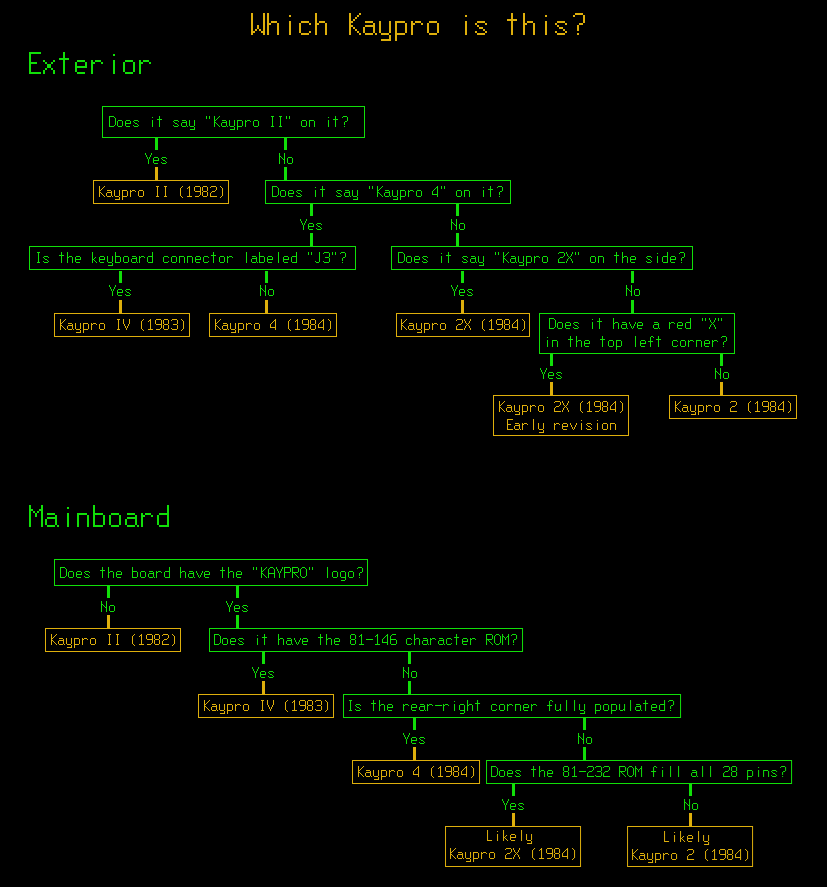
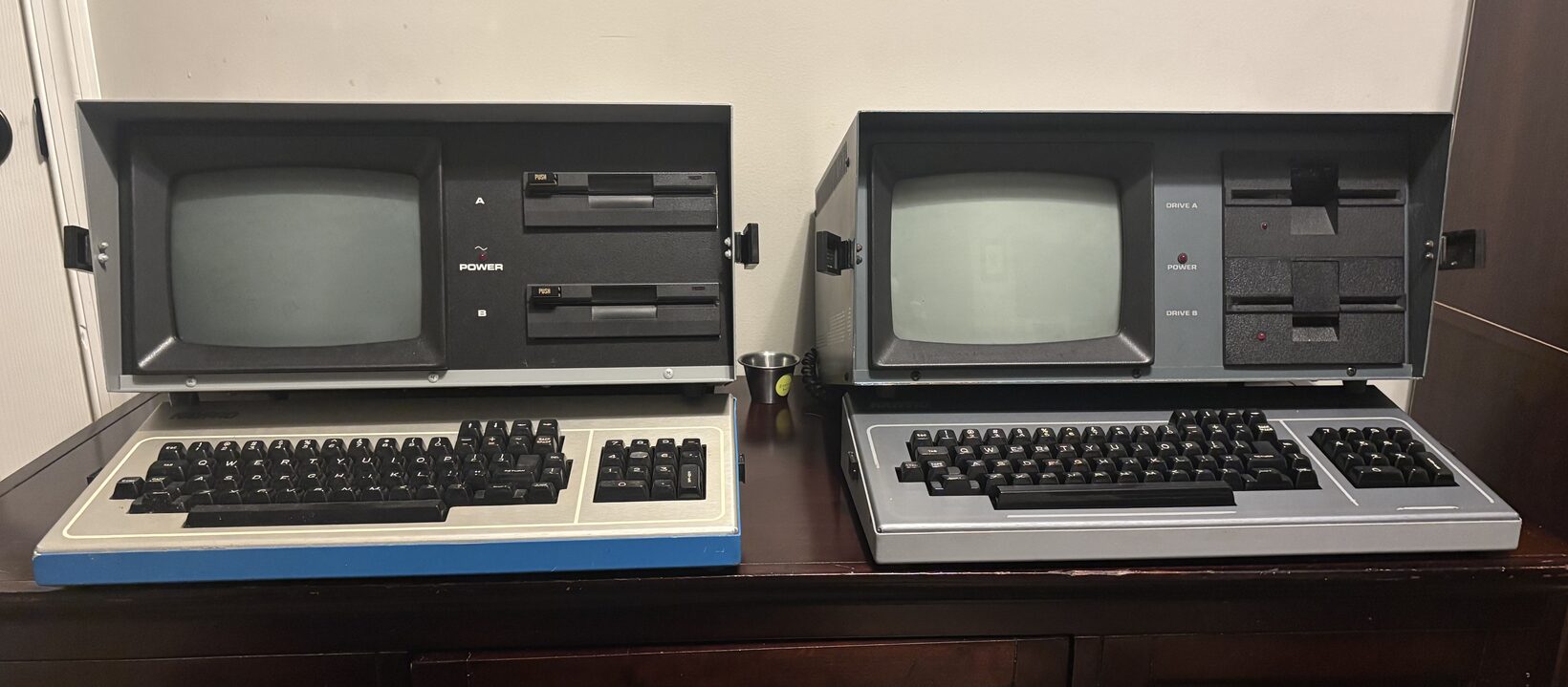
How can I tell the difference between Kaypro models?
Kaypro did a notoriously poor job of clarifying which computer was which. The Kaypro II, Kaypro IV, Kaypro 2, Kaypro 2X, and Kaypro 4 all came out within two years of each other and each had their own unique traits. This has resulted in misinformation that will be cleared up here. The computers can be divided into two eras: before the Universal Board and after the Universal Board. All models have 64 KB RAM, a Centronics parallel printer port, and a reversed RJ-22 port to connect the keyboard. The pre-Universal-Board models (the Kaypro II and IV) have an 80x24 screen, and the Universal Board models (the Kaypro 2, 2X, and 4) use the custom 6545 CRTC chip and have an 80x25 screen.
Before Universal Board
Kaypro II (1982)
The original Kaypro computer, named because it was one step ahead of the popular Osborne 1. This was produced before NLS (Non-Linear Systems) rebranded to Kaypro Corporation. The board primarily consists of discrete logic chips. The font is 8x8 pixels and text displays plainly, with the only special attribute being an optional blink. The higher bytes of the character ROM include the Greek alphabet.
Specs:
- Z80 CPU @ 2.5 MHz
- 200 KB SSDD (Single Sided Double Density) floppy disk drives
- 81-149 boot ROM
- 81-146 character ROM
- DB25 serial port
Kaypro IV (1983)
An upgraded version of the Kaypro II (1982) that featured a modified boot ROM and 400 KB disk drives. The new ROM is only 2.2 KB compared to the old ROM's 2 KB, and it changes the banner from "KAYPRO II" to just "KAYPRO" and adds support for the larger disk drives.
Specs:
- Z80 CPU @ 2.5 MHz
- 400 KB DSDD (Double Sided Double Density) floppy disk drives
- 81-232 boot ROM
- 81-146 character ROM
- DB25 serial port
After Universal Board
The Universal Board sought to replace the discrete logic chips from previous computers with a few custom chips that consolidate functions, such as the new CRTC chip that handles video. The rear-right corner of the Universal Board provided support for a 300 baud modem. The blink function from previous computers was supplemented with a new suite of hardware attributes including color inversion, underlining, and dimming. The character ROM was upgraded to a new 8x16-pixel font and the Greek alphabet was replaced by various shapes that can be combined to draw simple pictures. The smallest individually accessible area is 2x2 pixels, so the screen has an effective drawing resolution of 160x100 despite the character ROM being able to display up to 320x200 worth of characters.
The identity of the boot ROM is complicated. The Universal Board was meant to streamline computer development as the Kaypro Corporation branched out and produced a wider variety of computers. The new boot ROM, the 81-292, was thus meant to be a "universal ROM" that abandoned the hard-coded disk geometry from previous computers. Instead, it would auto-detect the drive type at boot so that the same ROM could be used across all later models. However, although a 28-pin socket was used to support 8 KB ROM chips, early computers from the Universal Board era did not make use of this "universal ROM" and instead duplicated a simpler 4 KB ROM across both banks of the 8 KB chip. The chips were not consistently labeled, meaning that a Kaypro 2 (1984) will have a chip reading "81-292" and this chip may be:
- a 4 KB ROM without auto-detection features
- a 4 KB ROM, mirrored to fill both banks of an 8 KB chip
- an 8 KB ROM that adds auto-detection features
This is a list of features only accessible to computers with the 8 KB 81-292 ROM or its later 81-478 revision:
- Hard-disk boot support
- Second serial channel (modem support)
- Automatic drive configuration
- Operating system detection
- Interactive keyboard input (other models rely on a chip inside the keyboard)
- System version reporting
Kaypro 2 (1984)
Despite the name, this is a brand new computer using the Universal Board. The rear-right corner of the board is unpopulated, removing modem compatibility.
Specs:
- Z80 CPU @ 4 MHz
- 200 KB SSDD (Single Sided Double Density) floppy disk drives
- 81-292 boot ROM
- 81-235 character ROM
- DB25 serial port
Kaypro 2X (1984)
The same computer as the Kaypro 2 but with added support for 400 KB disk drives. Early revisions only placed a small red "X" on the corner of the computer, but later revisions boldly placed the "X" on the side and front of the computer.
Specs:
- Z80 CPU @ 4 MHz
- 400 KB DSDD (Double Sided Double Density) floppy disk drives
- 81-292a boot ROM
- 81-235 character ROM
- DB25 serial port
Kaypro 4 (1984)
The same computer as the Kaypro 2X but with the rear-right corner of the Universal Board filled in, allowing for the use of a 300 baud modem.
Specs:
- Z80 CPU @ 4 MHz
- 400 KB DSDD (Double Sided Double Density) floppy disk drives
- 81-232 boot ROM
- 81-235 character ROM
- Two serial ports
Names
The inconsistent naming scheme of Kaypro computers has resulted in confusion over which model is which. This is a list of models and their common names:
- Kaypro II (1982)
- Kaypro IV (1983), Kaypro 4'83
- Kaypro 2 (1984), Kaypro 2'84
- Kaypro 2X (1984)
- Kaypro 4 (1984), Kaypro 4'84
There are two common shorthands and both have inconsistencies:
- Roman numerals are before the Universal Board and Arabic numbers are after the Universal Board.
Inconsistency: This is based on CP/M displaying "KAYPRO II" or "KAYPRO IV" on boot, but the names are stored on the bundled floppy disks and not on the computers themselves. The Kaypro IV has an Arabic "4" on the side despite using a Roman numeral "IV" in software.
- The "'84" suffix denotes being after the Universal Board.
Inconsistency: The 2X commonly lacks "'84" and is after the Universal Board. This also creates friction for the models before the Universal Board, with the Kaypro 4'83 having its year specified but the Kaypro II commonly not being specified.